Latest Composition - Oedipus
Process, and the Illusion of Choice

Man. Already at the twelfth post.
Will I make it to 120?
One post per week means that to reach 120 posts it will take almost three years.
It’s strange. It feels like a lot and very little at the same time. It’s strange to imagine having something relatively new to talk about every single week for that long. But then again — a lot will happen in three years. So… we’ll see.
This Week’s Focus
This week I want to talk a bit about my most recent composition: Oedipus.
I went back and forth between showing a previous piece (still not posted online) or this one — the one I’m currently painting. In the end, I chose the unfinished one.
Impostor Syndrome, Again
There’s always that lingering impostor syndrome creeping in — especially when it comes to personal work and large compositions.
There are too many variables. Too many decisions. Too many things I’m figuring out from painting to painting. It often feels overwhelming.
Sometimes I feel like I made a huge leap — but in reality, maybe only a small adjustment happened. Maybe it’s just my perception playing tricks on me.
It’s hard to know how a piece will land:
Will it justify itself through technical mastery?
Through confidence — or excessive confidence?
Through pure poetry, without obvious technique?
Or through something else entirely?
You never really know what a painting awakens in others.
When painting becomes your job, some of that magic changes. The distance that allows us to wonder — What does this make me feel? What does it change inside me? — becomes harder to access.
Curiously, I still feel that wonder very strongly in other areas: poetry, ideas, books, films, conversations, even scientific concepts. That sense of awe still inspires me deeply.
And with this painting, I felt something click again.
There’s a concept in science called emergent properties — the idea that the whole is greater than the sum of its parts, that quantity can generate quality, that more becomes different.
That idea fascinates me endlessly.
A New Painting in Progress — Oedipus
Why This Painting?
I can’t fully explain why I’m painting this piece — but I can trace some threads.
Around 2022, I started reading more about mythology. I’d always been interested, but never deeply. I read parts of books, jumped between stories, followed curiosity more than structure.
I remember stumbling upon the myth of Oedipus and the Sphinx and becoming fascinated — especially by how artists represented the Sphinx. I made a few sketches at the time, simple exercises in imagination. I didn’t yet have the tools to develop the composition further.
Recently, I’ve been thinking a lot about free will — or more precisely, the lack of it. I’ve been reading and listening to discussions around determinism.
And almost like a pop-up memory, that old Oedipus composition resurfaced.
At first, there was no conscious connection. I wasn’t thinking about determinism and Oedipus’ fate in parallel. (For the more attentive readers: predeterminism and determinism are different concepts, even though both point toward the illusion of choice.)
Only after returning to the sketch did I have a small Eureka moment — a bit like Epimetheus, understanding something only in retrospect.
Fittingly, I’m writing this while listening to a podcast where Robert Sapolsky is talking about determinism.
Maybe it was determined.
Process — From Abstraction to Image
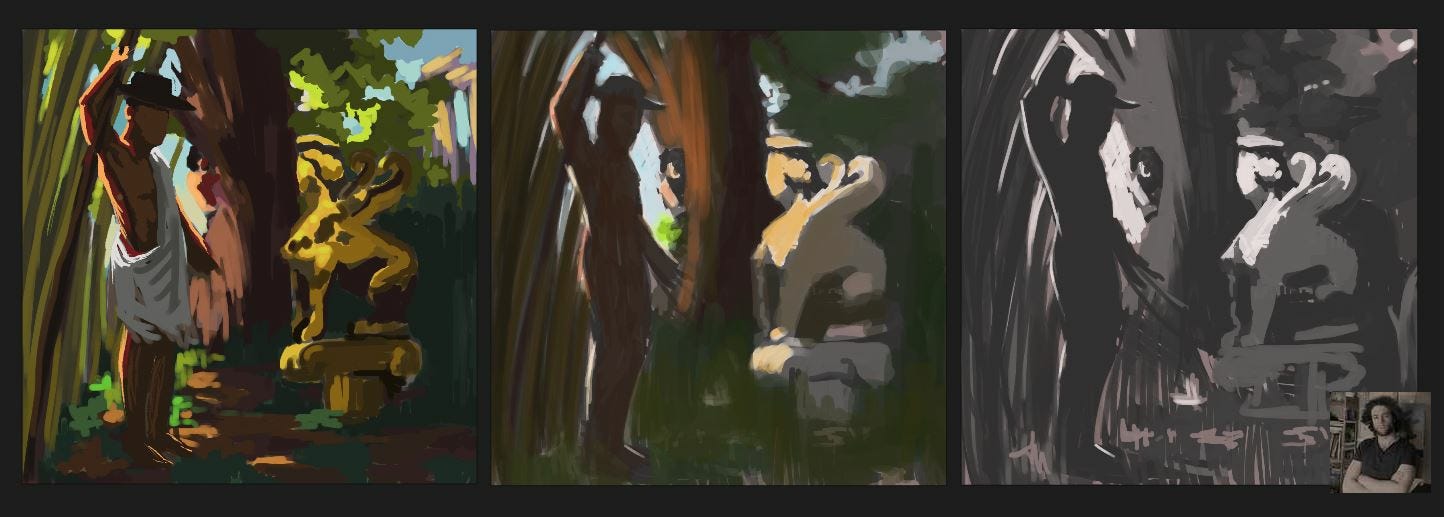
Stage 1: Abstract Shapes
The first stage of the painting is essentially abstract.
I searched for abstract shapes that felt strong and limited myself to five values. Once that value abstraction worked, I placed the references according to those shapes.
Then came color harmony — partly from imagination, partly from memory. Plein air painting has helped me enormously here.
One version pushes saturation further, especially in the lights.
Stage 2: References
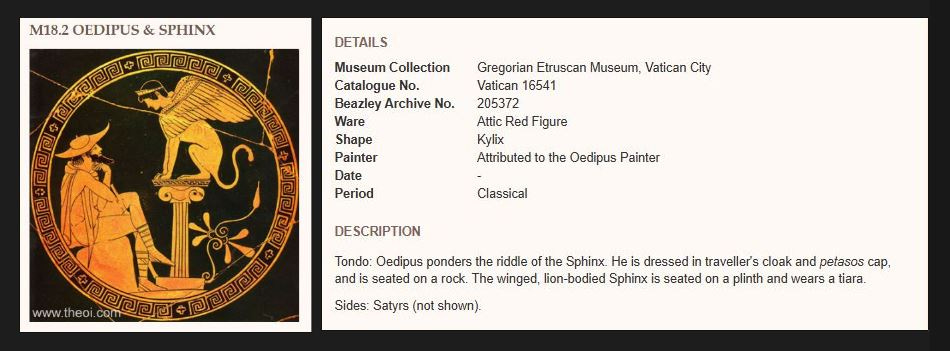
For the figure, I decided to reuse a satyr from an older, unfinished composition.
Curiously, while retrieving the reference to show you, I discovered that the side of the ancient vase actually depicts a satyr.
Sometimes, there are lucky coincidences.
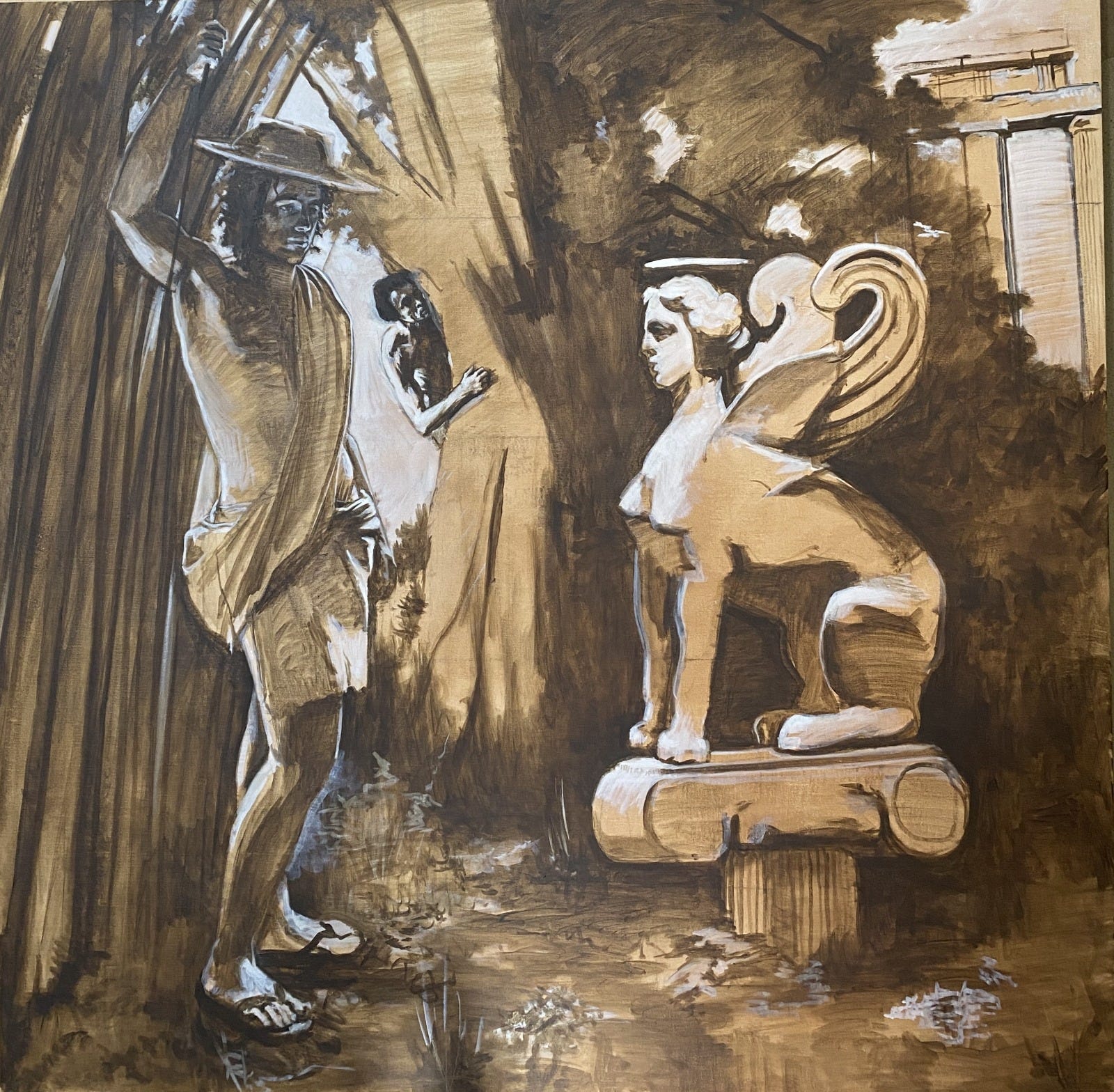
Stage 3: Drawing Stage
This is where structure, gesture, proportion, and placement start to lock together — still flexible, but no longer abstract.
What This Painting Is Teaching Me
This piece has reminded me of something important:
Meaning doesn’t always arrive first.
Sometimes form leads, and meaning follows.
Sometimes understanding comes after the action.
Much like Epimetheus — understanding only in hindsight.
Closing Question
As always, I’ll leave you with a question:
Have you ever worked on something only to understand why you were doing it much later?
I’d love to hear your thoughts.
Thanks for reading.